What 5W-40 actually means
Those numbers describe how thick the oil is — its viscosity — at two different temperatures. Thickness matters because oil has to flow instantly on a cold start to protect the engine, but stay thick enough when hot to keep a protective film between moving metal parts.
So a 5W-40 flows like a thin "5-weight" oil on a cold morning, then behaves like a thicker "40-weight" once the engine warms up. A 15W-40 is noticeably more sluggish on a cold start than a 5W-40, even though both protect the same way once hot.
The common grades you'll see on the shelf
Once you can read the code, the wall of bottles makes sense. Here are the grades stocked in most SA stores, from thinnest-when-cold to thickest, and the kind of engine each tends to suit. This is a guide to what the numbers mean in practice — not a substitute for your car's actual spec.
| Grade | Cold-start flow | Typically found in |
|---|---|---|
| 0W-20 / 0W-30 | Best — flows instantly cold | Newest petrol engines built around fuel economy and tight tolerances |
| 5W-30 | Very good | Most modern petrol and diesel cars |
| 5W-40 | Very good | Many modern engines, turbos and German diesels |
| 10W-40 | Good | Older or higher-mileage engines; common semi-synthetic grade |
| 15W-40 | Moderate | Older diesels, bakkies and commercial engines |
| 20W-50 | Slow when cold | Older engines (roughly pre-2000s) designed around thick oil |
Read it as a pattern: drop the first number (5W → 0W) and the oil reaches the engine faster on a cold morning; raise the second number (30 → 40 → 50) and you get a thicker protective film when hot. The catch is that the second number is only "better" if your engine was built for it — go thicker than the manufacturer allows and you do harm, not good.
Mineral, semi-synthetic or fully synthetic?
This describes how the oil is made, not its thickness. The three tiers, simply put:
- Mineral — refined straight from crude oil. Cheapest, breaks down fastest, suited to older, simpler engines.
- Semi-synthetic — a blend. A middle ground in price and protection.
- Fully synthetic — engineered molecules. Most stable across temperature extremes, handles longer service intervals, and is what almost every modern engine is designed around.
The golden rule: you can move up a tier, but never down. If your car calls for fully synthetic, putting mineral oil in it to save money is a false economy that risks sludge and accelerated wear. Going the other way — synthetic in a car that only asks for mineral — does no harm beyond the extra cost.
The spec matters more than the grade
This is the part the shelf label hides. Beyond 5W-40, manufacturers specify an approval standard the oil must meet — and on modern cars this is not optional. You'll see codes like API SP, ACEA C3, or an OEM approval such as VW 504.00, MB 229.51 or BMW Longlife-04.
The most important reason this matters in SA: cars with a diesel particulate filter (DPF) — common on modern diesels — need a low-SAPS oil (an ACEA "C" grade). Pour an ordinary full-SAPS oil into a DPF car and you slowly clog the filter, which is a five-figure repair. The viscosity might read identical, but the wrong spec quietly does the damage.
"It's 5W-40, so it'll be fine." Two 5W-40 oils can meet completely different approval standards. On a modern turbo-diesel or a German car under a service plan, the OEM approval is the part that actually matters — match it exactly.
Does SA's climate change what you need?
Less than people think — the manufacturer already accounts for hot climates. But two local habits are worth correcting.
The first is the old-school faith in thick 20W-50 for "our heat". That made sense for engines from the 1980s and earlier, and it's still fine for genuinely old motors designed around it. But pour 20W-50 into a modern engine specified for 5W-30 and you starve the tight tolerances, the variable valve timing and the oil pump it depends on — sometimes triggering fault lights. Thicker is not safer; correct is safer.
The second is forgetting that highveld winters are genuinely cold. A Gauteng or Free State morning near freezing is exactly when a low "W" number earns its place — a 5W or 0W reaches the bearings in a second, while a 15W or 20W is still crawling. Cold starts cause most engine wear, so the cold-flow rating isn't just a coastal concern.
If a previous owner or a backstreet workshop has been topping a modern car up with cheap 20W-50 because it's what was on the shelf, that's a quiet form of neglect. Always confirm what's actually in the engine against what the manufacturer specifies — not what someone assumed was "good enough for SA".
Where to find your car's exact oil spec
Don't guess and don't rely on the parts counter's best guess either. The definitive sources, in order:
- The owner's manual — under "lubricants" or "specifications". It lists both the viscosity grade and the required approval standard.
- The service book — a properly stamped book often records the exact oil used at each service.
- The oil filler cap — some cars stamp the grade or approval right on the cap.
If you've lost the manual, every manufacturer has an online oil-lookup by VIN or model. Use the VIN-based one where possible — it accounts for the exact engine in your specific car.
How to actually pick the right one
Put the shelf grades and the spec together and the decision is short:
- Start with the spec, not the shelf. The manual or fuel cap gives you the exact grade and the required approval. For most people that single line is the whole answer — buy that.
- If the manual shows a temperature chart, pick within it for your climate. Manufacturers often list a range of acceptable grades by ambient temperature. In SA's heat the higher hot-number end of that range is a safe choice; for near-freezing highveld winter mornings, stay on the low "W" end (5W or 0W). Never step outside the range the manufacturer prints.
- Match the oil type tier. Synthetic where synthetic is specified. You can go up a tier, never down.
- Match the approval. The API/ACEA/OEM standard — and a low-SAPS grade for any DPF car — overrides a merely "close enough" viscosity. This is the step people skip and pay for.
If two different bottles both meet your grade and your approval, they're equivalent for your engine — at that point brand and price are your only real choice.
What oil tells you when buying a used car
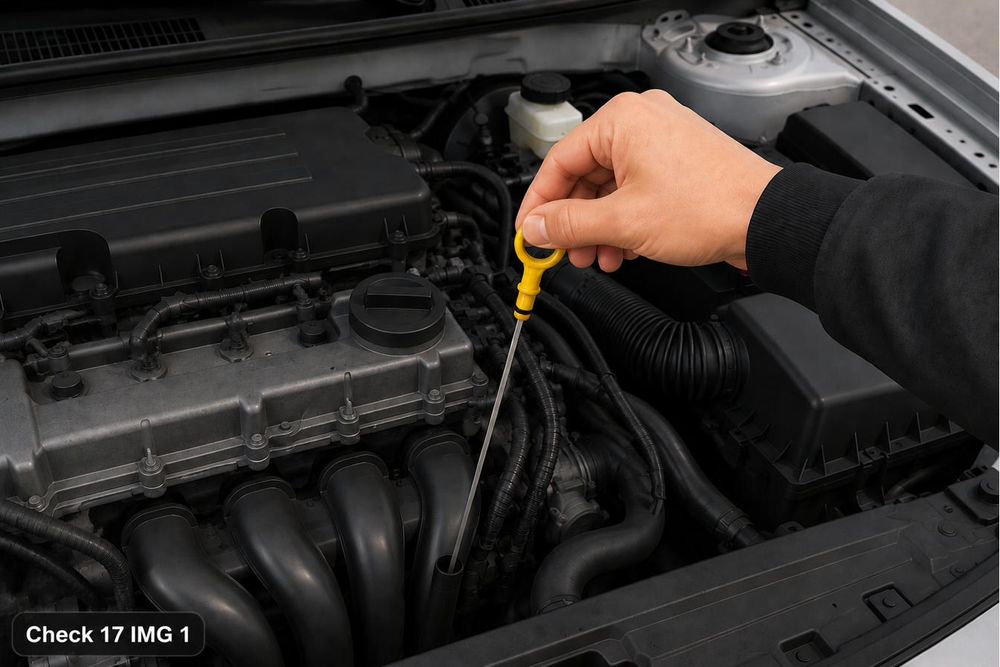
The dipstick is a 30-second window into how a car was treated, and it costs nothing on a viewing:
| What you see on the dipstick | What it suggests |
|---|---|
| Clean to light brown, correct level | Cared for — recent, proper service |
| Very black, thick, gritty | Overdue services, neglect, possible sludge |
| Milky / mayonnaise-like residue | Coolant mixing with oil — possible head gasket or worse. Serious. |
| Low level, oil smell of fuel or burning | Burning oil, a leak, or overdue change — investigate |
None of this replaces a mechanical inspection, but it tells you whether the owner's "full service history" claim holds up. Our Engine Bay inspection section walks through the dipstick, the oil cap residue and the fluid checks in full.
Match the grade and the approval — not just the price
Read the two numbers, never downgrade the oil type, and treat the OEM approval as non-negotiable on modern and DPF-equipped cars. When buying, pull the dipstick: clean oil at the right level is a quiet sign of an owner who looked after the car. Milky residue is a reason to walk.
Frequently asked questions
Get the free 60-point inspection checklist
Every check that matters before you hand over money — printable, and built for SA buyers.
Fluid levels, leaks, hoses, timing belt access, battery and engine bay red flags — the Engine Bay Inspection Guide walks you through what a mechanic checks first.
Get the Engine Bay Inspection Guide — R75 →This guide is general information for South African motorists, not a substitute for a professional pre-purchase inspection. Mechanical faults can be hidden or intermittent. Always have a qualified mechanic physically inspect the specific vehicle before you buy.