What "service history" actually is
Service history is the documented record of the scheduled services a car has had — when, where, at what mileage, and what was done. It usually takes one of three forms: stamps in a physical service book, a stack of workshop invoices, or a digital record held on the manufacturer's system. The strongest histories combine more than one of these.
The three kinds you'll see in SA
| Type | What it looks like | How to read it |
|---|---|---|
| Franchise / dealer history | Stamps from the brand's official dealers | Strongest on paper — but stamps can be faked, so verify |
| Independent workshop history | Invoices from a private mechanic or specialist | Perfectly valid, often cheaper servicing — confirm the work with the workshop |
| Digital service history (DSH) | Book may look blank; records sit on the manufacturer database | Common on modern cars — ask a franchise dealer to pull it by VIN |
A blank service book doesn't automatically mean a neglected car — many modern brands record everything digitally. But it does mean you need to verify the digital record exists, rather than taking the seller's word.
What it proves — and what it doesn't
A genuine history proves
- Services were done on schedule
- What was replaced and when (oil, belts, brakes)
- A consistent paper trail of the car's life
- Mileage that lines up with the records
It does NOT prove
- The car was never crashed or rebuilt
- There's no outstanding finance on it
- The VIN is genuine and not cloned
- It isn't an insurance write-off
This is the core misunderstanding: service history is about maintenance, not about the car's accident, finance or legal status. A spotlessly serviced car can still be a cloned write-off with money owing on it. You verify those separately — see our guides on checking the VIN and checking for outstanding finance.
Service plan vs service history vs warranty
These get mixed up constantly, and they're completely different things:
- Service history — the record of what's already been done. Looks backward.
- Service plan — prepaid future scheduled services, usually up to a set age or mileage. Looks forward, and is often transferable to you.
- Maintenance plan — broader than a service plan; also covers certain wear-and-tear parts.
- Warranty — covers repairs for defects, separate from servicing.
"It still has a service plan, so the history's sorted." A remaining service plan covers future services — it says nothing about whether past services were actually done. Always ask for both: the history behind it and any plan still running.
Red flags — how a thin or faked history gives itself away
- Promised but never produced. "History's available, I'll send it" that never arrives. Treat unseen history as no history.
- Stamps that look too similar. Identical ink, handwriting or alignment across years can mean they were all done in one sitting with one stamp.
- Gaps. A missing run of years or mileage. Ask why — it can hide a period off the road, a write-off repair, or plain neglect.
- Mileage that doesn't line up. The odometer reads less than a stamp recorded years ago — a classic rollback signal.
- "Full" history with two stamps. The ad says full; the book has gaps. The word is free to type; the stamps are what count.
How to verify it in about ten minutes
- Check the intervals. Compare the stamps against the model's actual service schedule — are the gaps roughly right for the mileage covered?
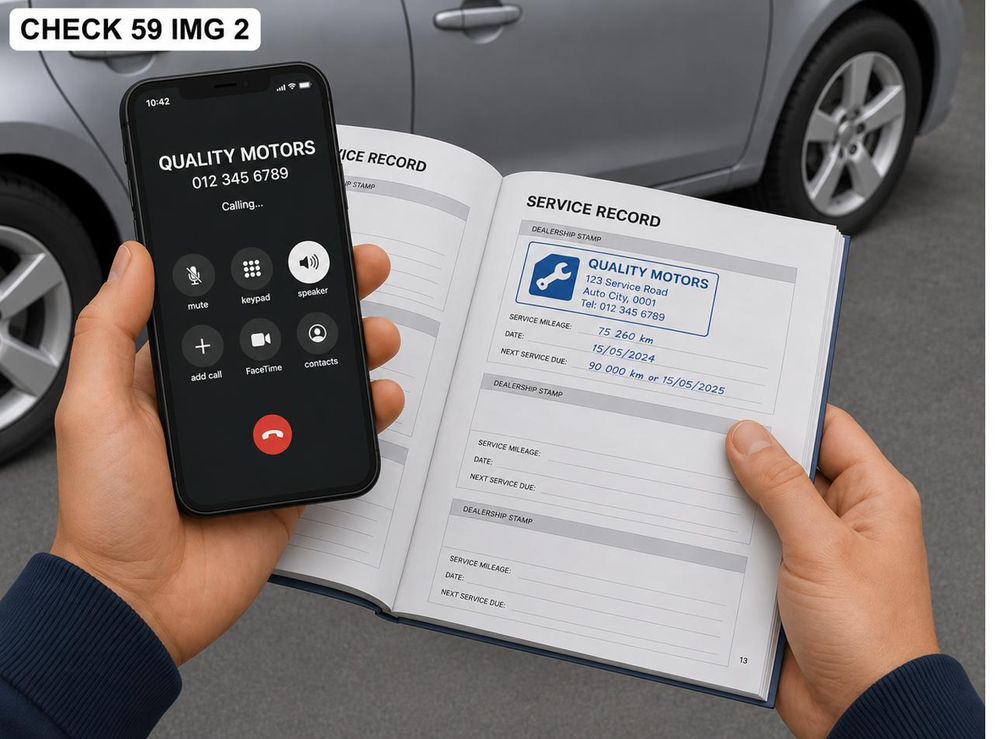
- Phone the workshops. Call a dealer or workshop named in the book, give them the VIN or registration, and ask them to confirm the service happened.
- Pull the digital record. For a car with digital service history, a franchise dealer can look it up by VIN — this bypasses fake stamps entirely.
- Match the big-ticket items. Tie major jobs like the timing belt to an actual invoice, not just a tick in a box.
What it should do to the price you pay
A genuine, verifiable full service history lowers your risk and justifies paying closer to the top of the market for that car. No history, or a history with unexplained gaps, should do the opposite — lower your offer and raise your scrutiny everywhere else. For some buyers, no verifiable history at all is simply a reason to walk, especially on a higher-mileage car.
A complete, verifiable history is one of the strongest things a private seller can offer, and one of the easiest claims for a chancer to fake. The difference is whether you can independently confirm it. If you can't verify it, price the car as if it has none.
Trust the verified record, not the word "full"
Service history proves a car was maintained — not that it's accident-free, finance-free or legally clean. Check the stamps against the intervals, phone the workshops, and pull the digital record by VIN. A history you can confirm is worth paying for. A history you only hear about is worth nothing.
Frequently asked questions
Get the free 60-point inspection checklist
Every check that matters before you hand over money — printable, and built for SA buyers.
NaTIS documents, roadworthy, service history and outstanding finance — the Documents Inspection Guide walks through every check that protects you from a paper-only scam.
Get the Documents Inspection Guide — R75 →This guide is general information for South African motorists, not a substitute for a professional pre-purchase inspection. Mechanical faults can be hidden or intermittent. Always have a qualified mechanic physically inspect the specific vehicle before you buy.