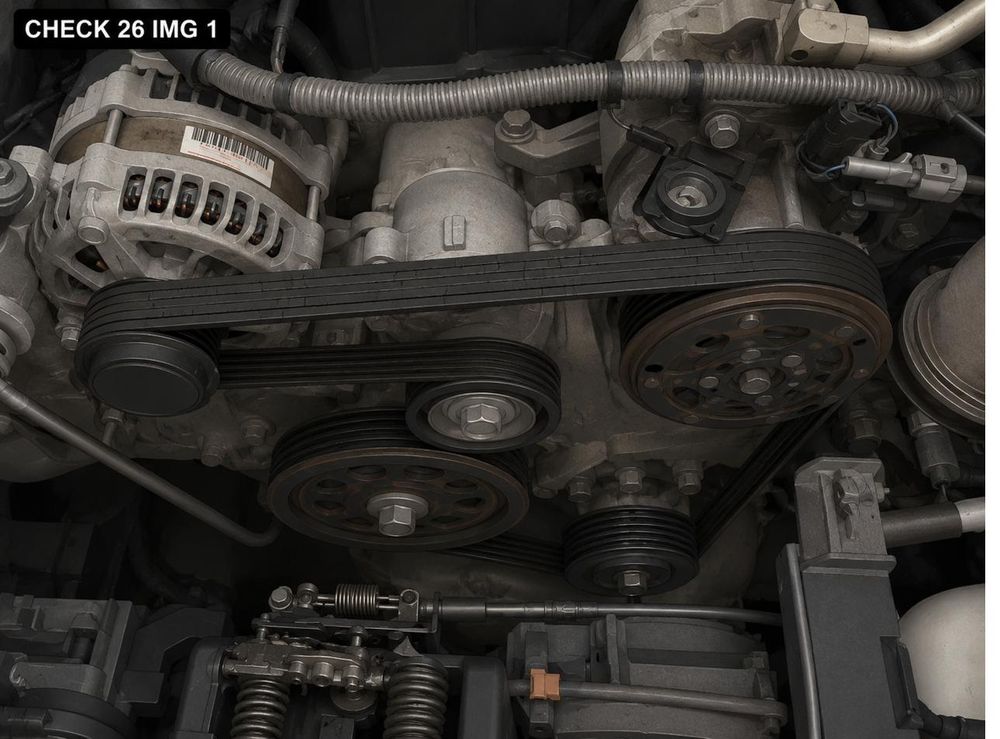
What the timing belt or chain actually does
Deep inside the engine, the crankshaft (driven by the pistons) and the camshaft (which opens and closes the valves) have to turn in perfect sync. The timing belt or chain is what keeps them synchronised. If that sync is lost — because the belt snaps or the chain jumps — the pistons and valves can try to occupy the same space at the same moment. On most modern engines, that means serious internal damage.
So this isn't a minor service item. It's the component holding the whole engine in time, and its failure is rarely a roadside annoyance — it's usually a tow truck and a big repair quote.
Belt vs chain — the real difference
| Timing belt | Timing chain | |
|---|---|---|
| Made of | Reinforced rubber | Metal links, runs in engine oil |
| Lifespan | Wears out — needs scheduled replacement | Designed to last the engine's life |
| Replacement | Planned service at a set interval | Only if it stretches or fails |
| Cost when due | A few thousand to well over R10,000 | Higher again — deeper engine work |
| Warning before failure | Little to none — it just snaps | Often rattles first, especially cold |
A belt is cheaper and quieter but is a consumable — the manufacturer sets a replacement interval, typically somewhere around every 4–6 years or 90,000–120,000 km, though some are shorter. Always check the specific car's manual; the interval varies a lot by model. A chain is meant to go the distance, but "meant to" isn't "guaranteed" — more on that below.
Why a snapped belt can destroy the engine
Engines come in two types. On a non-interference engine, the valves and pistons never share space, so if the belt breaks the engine simply stops — frustrating, but no internal damage. On an interference engine, they do share space, and only the precise timing keeps them apart. Break the belt on one of these and the pistons slam into open valves: bent valves, possible piston and head damage, sometimes a write-off.
Most modern engines are interference designs. That's why a timing belt overdue for replacement isn't a "we'll get to it" item — it's a gamble where losing costs you the engine.
Don't confuse the timing belt with the drive belt
This trips up a lot of buyers. The drive belt (also called the serpentine, fan or auxiliary belt) is the rubber belt you can see on the outside of the engine, turning the alternator, water pump, aircon and power steering. It's cheap and easy to replace, and if it fails you'll usually get warning lights and a chance to pull over.
The timing belt is hidden behind a cover, deep in the engine. When a seller says "the belts were done", make sure you know which belt — a fresh drive belt tells you nothing about the timing belt that actually matters.
"It's a chain, so I never have to think about it." Chains do stretch and fail — especially on engines run on neglected oil, or models with known chain or tensioner faults. A cold-start rattle that fades after a few seconds is a classic warning sign worth taking seriously.
Why this should change what you pay
Here's the part that hits your wallet. A timing belt service is expensive and easy to defer, because the car runs perfectly right up until the belt lets go. That makes it one of the most commonly dumped costs in the used market.
A seller offloading a car just before the belt is due is offloading a bill onto you. If the belt is at or past its interval with no record of replacement, you're looking at an immediate few-thousand-to-five-figure job — or the risk of a far bigger engine bill. Either way, that cost belongs in your offer, not in a nasty surprise three months later.
On a belt-driven car with no proof of a recent timing belt change, treat the replacement cost as money you'll have to spend soon, and negotiate accordingly. A documented recent timing belt and water pump service, on the other hand, is a genuine plus — it's a major expense already paid for.
What to ask and check before you buy
- Belt or chain? Find out for that exact model and engine — the manual, the manufacturer's specs, or a quick check with a mechanic will tell you.
- If it's a belt — when was it last replaced? Ask for the invoice. "I think the previous owner did it" is not proof.
- Match it against the interval. Compare the car's age and mileage to the manufacturer's replacement interval. Overdue with no record = budget for it now.
- If it's a chain — listen on a cold start. A rattle or whine in the first seconds from cold can point to a stretched chain or worn tensioner.
- Check the service history. Skipped oil changes shorten a chain's life. Our Engine Bay inspection section covers the cold-start listen and the history checks in full.
Ask one question, save up to five figures
Find out whether the car runs a belt or a chain. If it's a belt, demand proof of when it was last replaced and check that against the interval — an overdue belt is a real cost or a real risk, and it belongs in your price. If it's a chain, listen for a cold rattle and confirm the oil was changed on time. It's the cheapest check you can do for the most expensive failure you can inherit.
Frequently asked questions
Get the free 60-point inspection checklist
Every check that matters before you hand over money — printable, and built for SA buyers.
Fluid levels, leaks, hoses, timing belt access, battery and engine bay red flags — the Engine Bay Inspection Guide walks you through what a mechanic checks first.
Get the Engine Bay Inspection Guide — R75 →This guide is general information for South African motorists, not a substitute for a professional pre-purchase inspection. Mechanical faults can be hidden or intermittent. Always have a qualified mechanic physically inspect the specific vehicle before you buy.